05 August, 2014

Intramolecular

Editing the Wikipedia today. Added a diagram for the page titled, Intramolecular Diels-Alder cycloaddition. Go check out the page and start editing! It's a bit difficult thinking of things to write that's specific for the intramolecular reaction, but a picture was missing and so I filled the gap.

"Corey 1978 gibberellic acid" by Marvinthefish - Own work. Licensed under Creative Commons Attribution-Share Alike 4.0 via Wikimedia Commons - https://commons.wikimedia.org/wiki/File:Corey_1978_gibberellic_acid.png#mediaviewer/File:Corey_1978_gibberellic_acid.png

Going through the guidelines on drawing chemical structures for Wikipedia (see here), I used ACS format, changed a "Me" to "CH3", included the stereochemistry and used ChemDraw (13.0). Maybe I need to take out the English, to make it "language neutral". Not even sure if I need things like reaction conditions and yield.


01 August, 2014

DNA - not like that!

DNA project 'to make UK world genetic research leader' says the headline.

But when one starts with left handed B-DNA...

 *Cringe*

Oh well at least they're not trying to sell us anything...like in this example

 
STOP the spread of left-handed B-DNA!

18 June, 2014

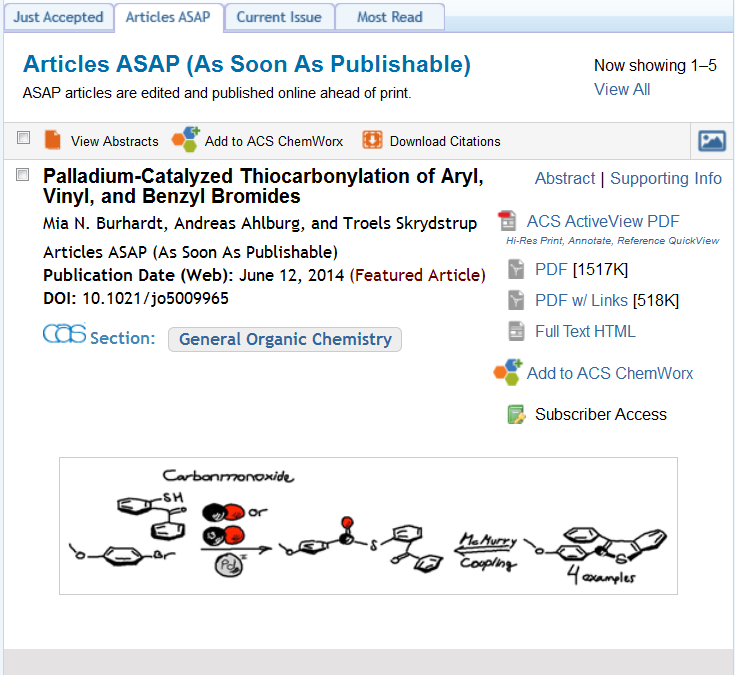
As SOON as publishable

What looks like a hand-drawn Figure 1. in this Journal of Organic Chemistry article. I can't spot any particular reason why it might be hand-drawn (as in, something clever which relates to the article itself). Any ideas? Also, that left-pointing retrosynthesis arrow seems inelegant to me. What's wrong with a standard reaction arrow?


13 May, 2014

Dorothy Hodgkin 12th May, 2014

Google's doodle on this day commemorated the "104th birthday"(is it still a birthday?) of Dorothy Hodgkin. I was happy to find I could recognise the molecule, before reading any further. I'm a real chemist (sounding like Pinocchio)! I particularly liked the Orange oxygen atoms :-)


Link to Google's explanation here (including  doodle drafts): http://www.google.com/doodles/dorothy-hodgkins-104th-birthday
...a pioneer of the field of X-ray crystallography. A 100 year old technique in chemistry which has revolutionized the way we understand the structure of the universe on a molecular level. By studying the patterns produced by X-rays, scientists are able to surmise the molecular structure of materials. A technique so important that it has had a direct role in producing multiple Nobel Laureates including Dorothy Hodgkin, who was awarded one in 1964 for her work on uncovering the complex structure of Penicillin G (the model in the doodle).

02 April, 2014

#RSCWiki2014

Skipping work* and heading in to London led to a wonderful day in Burlington House. A Wikipedia editing workshop was organised by the Royal Society of Chemistry and Wikimedia UK (a charity that supports and promotes Wikipedia and other Wikimedia projects).

*Looks back at original email application to attend* (paraphrased)


I want to learning more about editing and creating pages on Wikipedia would allow me to contribute more often than I do now. I have made a few small additions to pages, but feel I have been held back sometimes because of ignorance of the coding/formatting language (Just looked it up - "Wiki markup").

Editing wikipedia could give me the chance to have more interactions with the community of knowledgeable chemists around the world.

I would also like to learn more about linking, searching and applying chemical information on the internet. This would obvs be helpful to me in my career. Totes amazeballs,
Marvin

 Stuff I need for the day: (from my notebook)
  • Laptop
  • Camera (photos below!)
  • Fob for work account (access to ChemDraw)
  • Notebook (Moleskine, unlined, pocket sized)
  • Chargers
  • Water
So after a fairly enjoyable trip in to foggy London (along with some commuters), I stopped for a coffee (I was a bit early). A couple were talking loudly about theology (existentialism was definitely a word they used) behind me. At that point I knew it was time to bathe in the scientific waters of the Royal Society of Chemistry. The walk up:
#UnionJack #Fortnum&Mason #BlackCab #RedPhoneBox
 I came to the door and pushed (or pressed, I can't remember).

Picked up my name badge and headed in to start up my computer and get Wikipedia editing. One of the first things I learn is WP is a better abbreviation for Wikipedia than "Wiki" according to Charles Matthews, one of the Wikipedians teaching us. Interesting. We will build the house of the future.
If those vertices were carbon atoms, the structure would be unstable.
 After setting up Userpages, everyone listened to talks from Wikipedians and from representatives from the RSC. Charles Matthews went through one article in particular in order to explain topics around conflicts of interest. The article doesn't matter, just that it contained some advertising copy. He walked us through how to edit so that the final article was more neutral and clear. The afternoon was set aside for free editing of any page (or pages) you liked. I chose the page on actaplanin, because it was tagged previously as a chemistry page which needed an image. I also looked up the 1984 research on this antibiotic carried out by Eli Lilly, and a patent. Using my newly acquired Wikipedia skillz, I updated the page. I think I did an OK job for a beginner! Still lots to add and clarify, when I have time. The part I found most difficult was knowing when to stop. I've started a list of articles to edit, but it's growing rapidly. Maybe the way to go about this is to recruit more people.
"Arty" shot of Nelson's column

 *I'm a good fish and actually booked the day off 4-6weeks previously.

03 March, 2014

Experimental pancakes


Aim: Delicious pancakes for Pancake Tuesday
Date: Monday 3rd March 2014
Procedure: Plain white flour (300g, “essential Waitrose”) and salt (<1g, NaCl) was weighed out using the balance. This was passed through a sieve into a 2L circular bowl. A small depression was made in the centre of the flour. Eggs (three, medium-size hen eggs(free-range)) were cracked open and poured into the centre of the flour. Sunflower oil (22ml (1 ½ tablespoons)) was added next, followed by milk (100ml, semi-skimmed cow’s milk, 1.7% w/v fat content, ~5°C). The mixture was stirred vigorously using a whisk until all solid flour had become incorporated and a viscous paste formed.
Milk (100ml) was added to the paste and stirring continued for 2min. Milk was then added until a total of 450ml had been added, stirring continuously (may use a dropping funnel clamped above, if desired). The viscous liquid – the batter – was placed in the fridge overnight at 4°C ± 1°.
The next day, the batter was poured on to a hot pan and heated until delicious. 

Recommendations: Lemon juice (10ml. From Eureka lemon. Contains water, limonene, citric acid...) was added to the “pancake”, followed by sucrose (10g). Order of addition found to be a controversial issue.
Use fork or spoon to place in mouth. Masticate, swallow and digest. Smile. It’s Pancake Tuesday!

Suggestions for future experiments: To be updated


13 January, 2014

A trip to the dentist

Back in work today after a trip to the dentist. Still feeling the affects of this pretty little molecule:

Lidocaine
My voltage-gated Na channels in my neurons are starting to fire again, my lip and face are getting their feeling back and my liver is doing its thing, grinding this puppy into glycine deriviatives and adding oxygen atoms!

Lots of chemistry going on down at your local dentist. My jaw is now packed with an amalgam of mercury, silver, tin, copper and who knows what other metals (I'm hoping for ruthenium, one of my favourite metals! Unlikely) The dentist, using caution, described it as a "silver" filling. Having just yesterday finished reading "Bad Science" by Ben Goldacre, I can understand why the general public are a bit more scared of mercury fillings (Oooh just thought of a science-based joke : What do you call holes in your teeth after you've been to the dentist? Hg wells! Needs improvement, but I do like the different levels - the science fiction, the non-obvious acronym for mercury, Wells died just around the time lidocaine was discovered (first marketed in 1949, Wells died in 1946). My work is done for the day after that.)

When I arrived at work there was an email from the British Dental Journal (published by Nature) and I browsed through the list of article titles. Fluoride in water was one of the links. Sugar also comes up. Interesting, because I had not really thought about the effect of sugar on teeth when dietary sugar was being discussed in the media (at least, in the UK media) recently. Maybe I should try cut down on the ol' sugar. I do have a bit of a sweet tooth. Quote from the sugar article :

The Newcastle University study, commissioned by the WHO and published last month in the Journal of Dental Research, recognises the benefit of this threshold by showing that when less than 10% of total calories in the diet is made up of free sugars there are much lower levels of tooth decay. The new research findings go even further, suggesting that halving this threshold for sugars to less than 5% of calories – around five teaspoons a day - would bring further benefits, minimising the risk of dental cavities throughout life.


29 November, 2013

Chemophobia II

Chemical weapons are scary. I'm afraid of chemical weapons. But are chemical weapons more scary than other weapons?

The question, "Why are chemical weapons more scary than other weapons?" was posed by Mark Loach in his radio programme, "Chemophobia" (see yesterday's post), but he didn't seem to answer it fully. He gave the example of the horrific deaths in Syria from chemical warfare, and asked why this was worse than the greater number of deaths from conventional weapons. Of course, the terms "biological weapons" or "physical weapons" (or even just "weapons") are frightening too. Mark seems to suggest that "chemical weapons" is a worse prospect in the eyes of the general public.

Chemical weapons are devices that contain chemicals specially formulated to cause death or injury to humans. The properties of the chemical in the devices are the "weapon" rather than any physically destructive force of the device. The Organisation for the Prohibition of Chemical Weapons (OPCW, Nobel Peace Prize winners 2013 "for its extensive efforts to eliminate chemical weapons") administers the Chemical Warfare Control treaty, "an arms control treaty which outlaws the production, stockpiling, and use of chemical weapons and their precursors." (Wikipedia)

 Chemical weapons maybe are viewed as agents that cause irreversible damage, injuries that cannot be fixed and horrific deaths. It's clearly right for their use and manufacture to be banned. How should we reconcile banning these agents and not all weapons of all kinds? Biological weapons and "conventional" weapons perhaps can cause death and injury, of course, but maybe their effects are not seen as quite as bad, because there is an "antidote" or broken bones can be fixed, physical injuries can be healed, or chemicals (or drugs) can be used to cure a person. Chemical weapons can be non-lethal, but can leave someone "contaminated" or incurable.

Anyway, I feel like I'm getting out of my depth pretty quickly here. So I'll leave it there for now. If anybody would like to add anything or question me, leave me a message or a tweet.

Peace.


*Edit 22/12/2013* Periodic videos (Brady Haran) posted a...video on 2nd Sept 2013 on the topic of chemical weapons. Link. "Discussing chemical weapons, including Sarin and Mustard Gas.
Featuring professors Rob Stockman and Martyn Poliakoff from the University of Nottingham.
" As usual the video is entertaining and informative, more than I could explain here!

*Edit 2 22/12/2013* Further footage on the chemical weapons video linked above. link. Fritz Haber, binary weapons, "...it's a little unfair to attack chemistry for chemical weapons...", "In the end, the use of military force to solve political problems is something which I hope is becoming more and more unacceptable across the world"

28 November, 2013

Chemophobia I

The topic of chemophobia (the fear of chemicals) has come up in the chemistry blogosphere quite often in recent times. Here, for example, is Janet D. Stemwedel at Scientific American, asking what's the problem with chemophobia and why should chemists care and what response we should have.

ChemBark has written on the topic several times and has also addressed the question "…is it[chemophobia] really a problem? Who cares if the public dislikes chemicals? So long as chemists know better, we will continue doing good science. Why should we be distracted by general ignorance?".
Answer. Quote: "For a democracy...to function efficiently, the electorate must be educated and informed. The steady decline of chemistry’s public image is a massive problem, because it erodes support for our field."

Plenty of other blogs touching on chemophobia here, here and here, and here.

The most high profile discussion of chemophobia is now up on the BBC website. Mark Loach has a 15minute radio programme (Hmmm not sure if readers outside the UK will be able to listen to that. Just read the article if you can't - it's pretty much word for word) and an article which go into areas such as the definition of chemophobia, the usefulness of "bang, crack, fizzzz" chemistry demonstrations in sparking an interest in chemistry amongst young people (see my previous post on crack bang wallop demonstration I attended in Cambridge), and why physics or biology, for example, do not elicit similar fears in the general public. One of his most interesting metaphors was that a "sodium + water = bang!" demonstration he saw carried out by his grandad, was only "fuel" for his interest in chemistry. It was not the "spark", which for him came later in life. This fuel alone is not sufficient to ignite an interest in chemistry, he argues. We should concentrate more on the "little girl at the back of the room with her hands over her ears" and not just on the "boys at the front cheering and applauding" (paraphrased).

17 November, 2013

Cassiterite

Was competing in a challenge walk this weekend, and a set of general knowledge questions included naming the main ore of tin (I had no idea!). A quick Google (shhh! Anyway, we didn't win) revealed the answer as cassiterite. In various table quizzes I seem to remember these "what's the main ore of X" as common enough, but I still never have the correct answer. My question is, does anybody? Who is expert in metal ores? Are they social enough to communicate with others in a table quiz or online? Who makes this interesting?

Acanthite - Silver
Chromite - Chromium
Hematite - Iron (obvs!)
Ilmenite - Titanium
Magnetite - Iron
Cinnabar - Mercury (HgS)
Pentlandite - Nickel
Sphalerite - Zinc
etc.

12 November, 2013

"We'll start by making some gunpowder"

A quote from the lecture on Thursday evening, entitled "The Science of Fireworks and Explosives", which I attended with a few people from work. Prof. Chris Bishop was the master of ceremonies, and he did indeed make some gunpowder, firing a Brown Bess gun at the end of the lecture (loaded only with wadding)!


The lecture was advertised as a "family lecture", with "loud bangs, bright flashes, and some smoke". The fumehood used during the lecture just about dealt with the smoke, but did start giving out (beeping) towards the end of the lecture, when the accumulated smoke from the displays started to get too much. Even though it was aimed mostly at young people, I was engrossed by the displays, explanations and Bishop's red lab coat! The chemistry was explained in broad terms (sulphur=fuel, charcoal=fuel, saltpetre=oxygen), but there was interesting tidbits of information for those with a more in depth chemistry knowledge : Did you know a good ratio for gunpowder is 75:15:10 Saltpetre:Charcoal:Sulphur? It was explained that gunpowder produces quite a "soft" explosion (more of a "push", hence its use in fireworks, for example). But what if you want a proper bang/crack? The talk then moved on to metals, both in flash powder (metal fuel) and fireworks (colours). The predictable metal-salts-in-a-Bunsen-burner section was spiced up a bit by the use of methanol solutions of salts like SrCl (red), NaCl (orange), CaCl (orange) and CuCl (aquamarine). The MeOH spilled on to the floor at one stage, starting a small fire! Some of the parents looked a bit worried, but Chris's able assistant walked to the side of the stage to receive a fire blanket. (Waving it over the fire, rather than placing it carefully!)
Another picture from the lecture. This is of lycopodium powder being blown through a Bunsen flame.
 Then the main topic : fireworks. Types (four classes : 1. Indoor 2. Garden 3. Display 4. Professional), effects (white glitter, strobes, orange popping, screechers)

Finally nitrocellulose, dynamite, HMX tubing, nitrogen triiodide (very loud!)

This child exploded into just CO2 and water shortly after this photo

05 October, 2013

Shopping list

Gone a bit mad with the shopping these past few days :

  • Fleece
  • Waterproof trousers
  • Helmet
  • Inner tube
  • Cycle jersey
  • Bottle cage
  • Parsnip and apples (for a Hugh Fearnley-Whittingstall recipe)
  • Just subscribed to Netflix
Ok calm down. I can stop spending money. At least until tomorrow...
 

19 April, 2013

Extra extra! Children on a bus for a couple of hours longer than expected!

Is this the most boring piece of news ever? Yes, yes it is.

http://www.bbc.co.uk/news/uk-wales-22212456

A sat-nav mix up left a coach load of school pupils almost 80 miles from home after a trip to Paris.

Oh my god what happened??
The children from Tywyn, on the west coast of Wales in Gwynedd, ended up a couple of hours away at Towyn, on the north Wales coast near Rhyl.

I have been to Rhyl. If you were expecting to be somewhere else, it's not the most exciting place to spend time.

Pupils woke up after the 13-hour journey and phoned parents to say they were in the wrong town.

Again, oh my god oh my god oh my god! 

"The main thing is they all got back safely." said Gwynedd councillor Louise Hughes, a school governor whose daughter was on the trip.
"Delivery drivers make the same mistake and people ring saying 'we can't find you, we're in Towyn'. It happens all the time."

How is this national news?
Zzzzzzzz...

15 March, 2013

Beware the Ides of March

Since I am now officially famous (http://cen.acs.org/articles/91/i8/Real-Time-Community.html), I suppose I should not let this blog die off completely.

So here we are again and it's mid March. The 15th of March was called the Ides of March by the Romans and Julius Caesar was assassinated on this day in 44BC. I was browsing a popular user-edited online encyclopedia when I happened upon this article about the IOM. Towards the bottom of the page was this interesting fact :

Intrigued, I followed the link and read about these delicious sounding libations (wow I just googled that word and it's actually perfect for this sentence...Also, how do you like that sibilance? :-) ), because I'm going out for dinner tonight and I want one now! Not sure if the restaurant will stock the necessary clam broth, but I suppose I can get a Bloody Mary instead. *goes to check menu for any sort of clam dish*


20 November, 2012

Friend. Slave. Industrious.

Richard Friend
Sir Richard Friend
Professor Sir Richard Friend
(building a name for yourself)

As this 'blog is also a diary of my exciting life, I would like to tell you about a lecture I attended this evening. Professor Sir Richard Friend was speaking in the Department of Pharmacology on Tennis Court Road, Cambridge. The title of his lecture was, "Plastic Electronics", and was organised by the CUSS (Cambridge University Science Society) He has set up several companies over the years, and gave a general overview of the topics of Oled's, transistors and solar cells.

At one point he gave the opinion that some working in academia or looking to do a PhD would not choose to work with companies in this area (including companies he founded) because it was "slave labour"! Also, it was "cheap industrial research" and not "fundamental research". I think his point was these companies are just building on his original research, improving lifetime, efficiency, colours, process-ability and the like, rather than exploring totally new areas of SCIENCE.

There was both chemistry and physics terms in his talk and sometimes it got a bit confusing.

 Just realised he looks a bit like the former French president, Nicholas Sarkozy. Lol.

09 November, 2012

Fire safety. Labcoats. Link to ChemBark.

I attended a fire safety training course today with some of my colleagues and some Department of Chemistry PhD people. We got to play around with all the different types of fire extinguishers and put out Pet. ether fires and acetone fires. We also used fire blanket to put out a fire in a barrel. The grand finalé was a demonstration of a fire that could happen in the lab. Beakers of solvents were set on fire and then knocked over (with the handle of a broom), leaving a bench in flames and a pool of fire on the floor. Volunteers from the audience (not me, my scales are far too delicate) then attacked the inferno with various extinguishers (a large foam extinguisher worked best, moving from the floor fire, to the bench).

That's a lot of fire extinguishers...


One thing that caught my attention though, was the lab coats that were there. One was hanging up and one was lying flat on the bench (to demonstrate that one should drop and roll when one is on fire in a lab coat). But also, one was made from polyester, whereas one was 100% cotton (to be a proper scientific experiment they should have had a) one cotton lying down, b) one cotton hanging up, c) one polyester lying down, d)one polyester hanging up) I digress. Obviously the synthetic material burned faster and became brittle and charred, whereas the cotton turned black, but was still pliant and identifiable as a fabric. When I got back to my lab afterwards I checked my labcoat. 65%polyester blend. Oh F* I'm Going To Die In A Horrible Fire. Even worse, I'll be wearing polyester blend when I do it.

This evening at home I used a popular search engine to find out more, and ChemBark wrote an excellent post on this subject two years ago (soon after the Sheri Sangji case). I strongly encourage you to read it (go! now. Use the link there in the first sentence. I'll wait here. If you've reached this far, you clearly have an interest in lab safety. Go on.) He was discussing what to look for when buying a labcoat. Where I work, I am provided with a labcoat the same as everybody else's. After reading ChemBark's post I'm nervous about not having a better lab coat. Where I work we can pick out our own safety shoes and lab goggles and there's different types of gloves for everyone, but everyone gets the same labcoat (in various sizes). Anybody have any further thoughts on this (a lot of good ideas in the Comments in that ChemBark post)? Has anybody pushed this issue at their place of work and how did you go about it?

MTF


08 November, 2012

Real chemistry. Time.

"Quantity not quality. (We'll see how long this lasts, but everyone knows the most annoying type of blog is one not regularly updated)"
Post 1 MarvinTheFish blog
Yeah so that didn't happen! Let's move on and not learn from it and be embarrassed about it again in a few months' time.

Here we are in November and yesterday was #RealTimeChem day. I had a lot of fun following this hashtag on twitter, as well as showing people some of what I do during the week (don't do labwork on weekends these days). You can see what I was up to on my twitter. I made quite a few new "twitter friends" like @AzaPrins @Doctor_Galactic, @JessTheChemist and of course @RealTimeChem, among others. @ChemistryWorld quoted one of my tweets on their blog. It was the first time I felt the full power of this twitter-malarky, getting retweets, and people favouring my pictures. Also, some of my original followers and real-life friends got involved, responding enthusiastically to the #realtimechem event! I'll allow @Doctor_Galactic to explain the origins of the event. I recommend you go read his blog if you're interested :http://doctorgalacticandthelabcoatcowboy.wordpress.com/

Who invented #RealTimeChem?
Certainly not me. However, I have been participating for a while on an off in doing some #RealTimeChem tweets. I believe that the inventor was @azmanam who was trying to determine what was in Lemishine and happened to tweet his results using, and @JessTheChemist produced a storify page to follow all the RealTimeChem that happened. Since then it has caught on a many others have joined in to tweet their chemical reactions in real time using the same hash tag.

I was slightly concerned with IP issues, tweeting my actions live during the day and the (remote) possibility of being retweeted around the world. Even tweeting at work is frowned upon, with work WiFi not allowing it, and twitter.com blocked on PCs. When my phone told me that I had been quoted in a CW blog post, I imagined my colleagues reading it and pointing out obvious IP issues that I hadn't seen! It worked out fine though and I think the images and words I posted were fairly generic, and not something I wouldn't tell strangers anyway. Again, @Doctor_Galactic :


What do I have to do to join in? What should I tweet?
To join in you simply have to tweet about your day in your particular field of chemistry using the hashtag #RealTimeChem to show that it is part of the event.
Incidentally, pictures of your day (such as great looking experiments) are most welcome. Obviously, only take pictures of things you are allowed to show, we understand some chemistry must be shrouded in secrecy.

Overall #realtimechem was fun, and valuable for connecting chemists around the world. It gave me the sense of belonging to a community. People doing similar things (and more interesting things!) to me, using the same equipment as me. Looking forward to next year.

28 August, 2012

Go for the jugular

Go for the Jaguar
Go for the juggler (usually annoying)
Go for the jug

“You’re looking for money and jewellery; just get the cash . . . You can sell the jewellery, you’d sell it anywhere. Moorcroft bowls are a big seller as well. Just go up to Ballymun or somewhere. There’s loads of people up there owe money to the credit union or the loan sharks. You bring something up there that they know they’ll never be able to get unless they buy it from you at a knock-down price and they’ll give you money for it, f***ing sure they will.” [Emphasis MTF]

http://www.irishtimes.com... <---Link

I was reading an article about recession burglars in The Irish Times last month and this paragraph was just slipped in. I'm still trying to understand it. Just, what? Moorccroft bowls? Moorcroft bowls seem like a fairly specialist subject, and I'd never even heard of them, but apparently they are the item to grab when you're in a house which is not your own and flaking off your latest high and doing whatever it needs to get the next. No explanation as to why these particular bowls are the hotch of choice. I presume the street value on one of these bad boys must be special.

GET IT I THINK I HEAR SOMEONE AT THE DOOR


01 August, 2012

Amazing, but who's his Dad?

A fortnight since my last post and  quite a bit has happened in the world since then. Of course the Olimpics have started in the capital city of the UK.

To celebrate, here's a quiz (a la bikesnob). In celebration of the bbc's insistence on searching out the fathers of any successful sportsman. See if you can match the sportsman with the Dad.
To take part in this quiz, simply print out the photos below, and send your guesses to Marvinthefish, 7 Under-the-Sea, England. Top prize : mention on this blog, plus a hyperlink to your blog/twitter account.
Gold duck!

Chad LeClos
Jenson Button

Lewis Hamilton
Nicolas Roche